Unstructured party addresses run out of road in 2026.
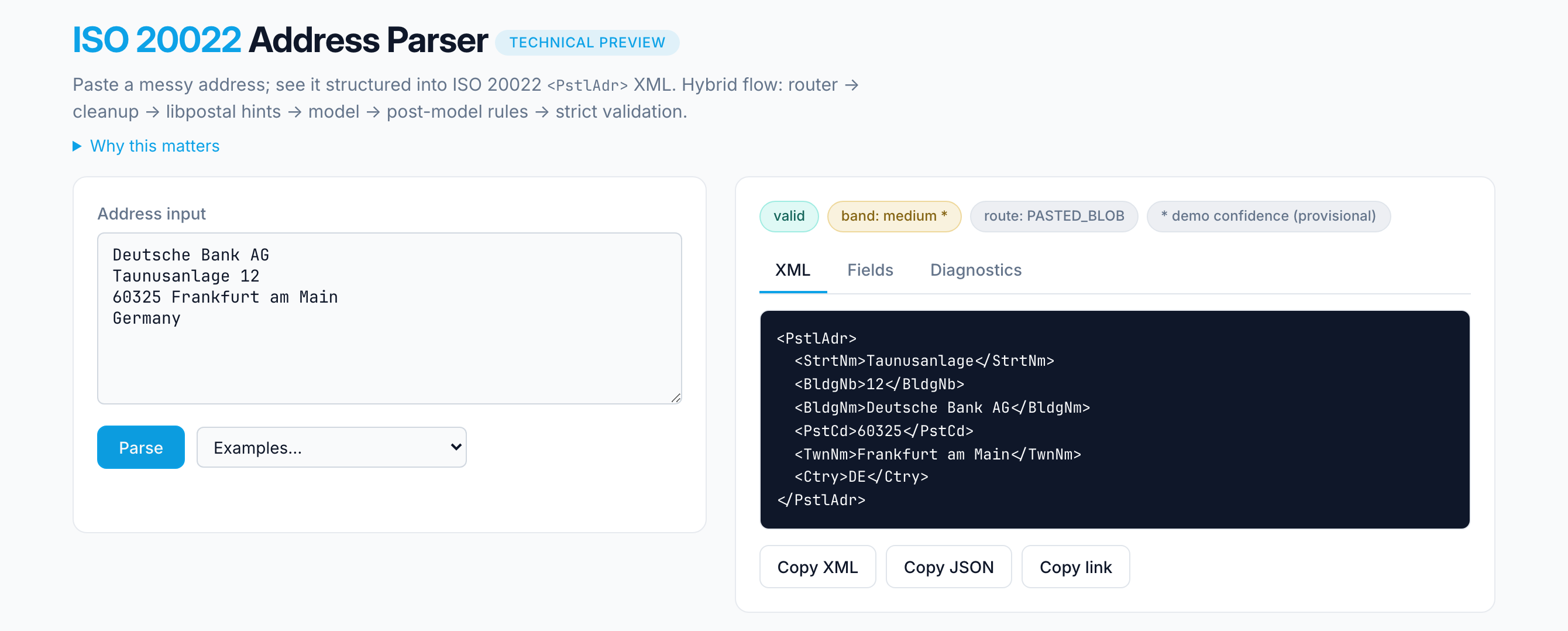
From November 2026, fully unstructured postal addresses are deprecated in CBPR+ ISO 20022 payment messages. Party address data, including customer records, beneficiary files, and message archives, needs structuring before that gate. This preview shows one hybrid approach to that conversion.
A hybrid parser, not a single model call.
Every input runs through a fixed pipeline. Statistical tools and deterministic rules handle the predictable parts; the model handles the messy parts; strict validation gates the output before you ever see it.
Routing
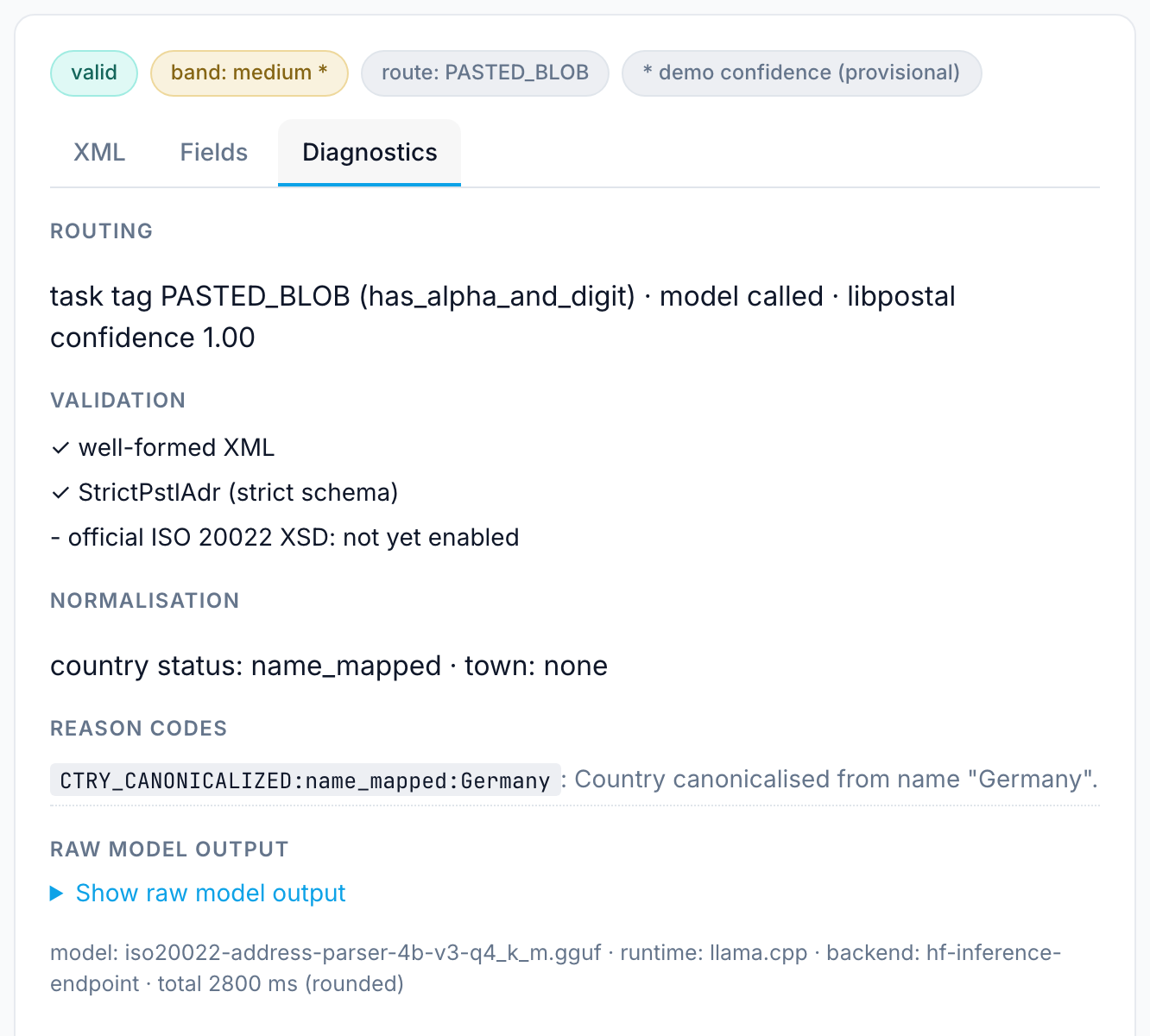
Classify the input shape: pasted blob, MT-style block, CSV row, already-XML, or non-Latin script, then route it down the right path.
Cleanup
Pre-model normalisation strips MT line-continuation artifacts, zero-width characters, and stray whitespace before anything is interpreted.
libpostal hints
Statistical address parsing with libpostal, loaded and serving, proposes field hints that ground the model and guide abstention.
Model inference
A fine-tuned 4B model, served on a private, token-gated Hugging Face Inference Endpoint, emits the structured <PstlAdr> block.
Post-model rules
Country canonicalisation, postcode and PO Box handling, and town normalisation correct the common model slips deterministically.
Strict validation
Well-formed XML and a strict PstlAdr schema check run before display. Official ISO 20022 XSD validation is not yet enabled in this preview.
Preview examples span Germany, the UK, India, Singapore, Russia, and Saudi Arabia. Batch review and bulk upload are not part of this preview.
Built as middleware, not a one-off prompt
The parser is designed to sit between legacy address sources and ISO 20022
message preparation. It takes messy party-address text, returns structured
PstlAdr XML, and exposes review signals so teams can
decide what to trust, what to route, and what still needs human review.
-
Fits the messy inputs teams already havePasted address blocks, MT-style lines, CSV-style rows, already-XML fragments, and non-Latin scripts can enter the same workflow.
-
Structured output for downstream systemsThe result is not prose. It is a structured
PstlAdrpayload with field-level output, XML, diagnostics, and confidence signals that can be wired into review tools or migration pipelines. -
Hybrid workflow, controlled boundariesThe model is only one part of the flow. Routing, cleanup, libpostal hints, post-model normalisation, and validation gates make the workflow easier to inspect and safer to operate.
-
Review-first confidenceConfidence bands are designed for triage, not autopilot. They help teams decide what can move forward and what should be sampled, reviewed, or rejected.
-
Abstention instead of inventionWhen the input does not look like an address, the workflow can return "No address detected" instead of forcing a plausible-looking output.
-
Private backend pathThe browser never receives the model token or private endpoint URL. The page talks to same-origin API routes, while model access stays server-side.
What happens to what you paste.
The same posture is shown inside the app, on every screen.
How inputs are handled
- The frontend talks only to its own same-origin
/apiendpoint. - Inputs are processed by the gated demo. For invited evaluation accounts, submissions and parser outputs may be logged for debugging and product improvement.
- Links may include the current input in the browser URL fragment, so copied or shared links can contain it.
- Nothing loads from a third party: no external scripts, fonts, analytics, or trackers.
Use public business addresses only
Use public business, bank, or organization addresses only. Do not submit personal data, account numbers, confidential payment records, internal repair cases, SSI records, or licensed bulk reference-data exports. This is a demonstration of address-structuring capability, not a production compliance system.
Open the technical preview.
See the hybrid parser run on real public business addresses, with the full routing, normalisation, and validation diagnostics shown for every result.